
- LicensedTexas Master Plumber 40980
- On call 24/7Licensed plumbers for emergencies
- Brazos ValleyCollege Station, Bryan and nearby
A leak you cannot see still does damage every hour it runs. The repair is rarely the hard part. Finding the water is. It could be a line in the yard, inside a wall, above a ceiling or under a slab. It could just as easily be the irrigation or the pool plumbing. We test each of those a different way.
4L Contracting locates water leaks for property owners in College Station, Bryan and the nearby Brazos Valley communities. Written pricing comes before authorized work begins.
Call 979-473-9775Request an Appointment
THE SIGNS THAT SAY YOU HAVE A LEAK YOU CANNOT SEE
Several things point toward a hidden leak.
| A meter that keeps moving with everything shut off |
| A bill that climbs with no change in habits |
| A damp or discolored patch on a floor or wall |
| A musty smell in one room |
| A drop in pressure |
| An area of lawn that stays soggy or unusually green |
| The sound of water running when nothing is on |
Any one of those is enough to make a leak worth looking for.
A single sign tells you a leak is worth investigating and tells you nothing about where it is. The location is what the visit is for, and it requires a systematic approach rather than an educated guess about which wall to open.
The longer a leak runs, the more of the total cost is damage rather than plumbing repair. Wet framing, softened drywall, mold in a wall cavity, and warped flooring all accumulate quietly over weeks or months, and none of that is covered by a plumber’s workmanship warranty because it is not plumbing work. The sooner we pin down the source, the smaller the scope of everything downstream.
THE METER TEST YOU CAN RUN BEFORE YOU CALL
Shut off every fixture and appliance that uses water in the building, then walk to the meter and watch the low-flow indicator for movement. Most meters have a small dial or triangle that spins when even a trickle is passing through. If that indicator moves with everything closed, water is leaving the system somewhere.
The next step is to close the main shutoff at the house and go back to the meter. The indicator may still move with the house isolated. That means the leak is between the meter and the building, in the service line in the yard. If the indicator stops once the house is shut off, the leak is somewhere inside the building. That single test separates the yard side from the inside and points the investigation in the right direction.
What this test confirms is that a leak is real and roughly which side of the shutoff it falls on. What it does not do is locate anything precisely, tell you whether the line is pressurized or a drain, or identify the repair. That is what the visit is for. Running the test before you call gives the plumber useful starting information and can shorten the time spent on the property.
What our customers say
Published exactly as written, straight from Google.
Found late Friday evening that I did not have hot water, and it was the weekend... YIKES!! Contacted 4L Contracting LLC; they came out within a couple of hours and had me working in a short time. Lee went above and beyond, letting me know about other problems identified in my attic, a problem with my chimney, and a heating vent installation problem. After he left, I found a water leak in the laundry room ceiling. He turned around and came back to my house. He found the air conditioning drain pipe was backed up. He blew it out the drain pipe, preventing a big disaster. So appreciate his thoroughness and helping me on a Friday after-hours house call. He definitely went above and beyond.
I had a great experience working with 4L Contracting LLC. They were awesome to work with, they were professional, responsive, and clearly knew what they were doing. We had a massive leak that needed immediate attention, and they showed up quickly and handled it efficiently. They not only fixed the issue fast but also made sure everything was done right. I would absolutely recommend them to anyone needing reliable, high quality work!
Used 4L Contracting the first time a couple years ago and since then they have replaced a water heater, reset toilets, replaced water lines, and located and fixed a leak under the house! They have been amazing to work with over the years, I cannot recommend these guys enough!
Water Softener installation Completed! Just wanted to give a shout out to Kurt and Lane on their outstanding customer service today. I hired 4L Contracting LLC to install a water softener in our home. After finding out the water softener I had purchased was missing parts, the job was rescheduled for Monday. I was able to return the water softener and get a replacement fairly quick. So I sent a text to Kurt, letting him know I had done so. He informed me they were nearby and could do the job in about 30 minutes if I could meet them back at my home. I hurried home and in about 2 hours the job was completed. Tonight my wife and I shall enjoy a soft water shower!
My husband and I had a broken pipe in the foundation and it was leaking pretty bad into our hallway, and 4L Contracting came that day we called, assessed the issue, and was back the next day and completely fixed the problem. They were so nice and helpful! I cannot tell you how pleased we were with their service. I recommend 4L Contracting!
My wife and I discovered a water leak coming out of our wall. 4L Contracting LLC came out that day and found where the leak was coming from (copper pipe leaking in the slab), they started working immediately and finished the next day.
These plumbers are honest, knowledgeable and reliable! They helped us fix a leak and answered all our questions about other issues in the house. Highly recommend!
Lee and his guys are Great. Their communication on our projects have been superb! Always letting us know when they will be at the job site. Lee is doing 3 projects for our Airbnb's at one time, and his organization of his paperwork is paramount for us.
A WATER BILL THAT JUMPED WITH NO OBVIOUS CAUSE
A bill that rises with nothing visible on the property usually means water is going somewhere the owner cannot see. The two most common answers are a line running underground and a toilet passing water silently into the bowl. Both are easy to miss because neither shows up as a wet floor or a dripping fixture.
We check the straightforward things first, because a customer should not pay for a full leak search that a worn flapper valve explains. A running toilet can account for a meaningful increase in usage. There is nothing to see, and no sound audible in a noisy household. So we rule those in or out before we move further into the system.
We compare what the meter actually records against what the property is confirmed to be using. We do not assume the bill is correct, or that the utility read is accurate. Utility reads can be estimated, and meters can overclock. So we verify what the meter shows against a timed flow at known fixtures. That is part of sorting out whether a bill reflects a real loss or a metering problem.
WHAT IT COSTS AND HOW YOU PAY
Locating a leak and repairing a leak are two distinct pieces of work. The second is quoted once the first has told us what the repair actually is. A price for the repair cannot come before the plumber knows four things: which pipe has failed, and where it is. What material it is made of, and what access the repair requires. Those are confirmed during the detection visit, and the written repair estimate follows from that.
Written pricing is provided once the plumber has assessed the situation and identified the scope, and you authorize the work before it starts. There are no charges added after authorization and no verbal estimates that turn into larger numbers on the invoice. The estimate process is explained in full on our plumbing prices page.
Written Before Work Starts
The written proposal or invoice states the scope, the covered work, any exclusions and your obligations as the customer. You sign off before any tool is picked up for the repair.
Workmanship Warranty
our workmanship warranty applies to the repair work performed. Covered work, exclusions and customer obligations are stated in the written proposal, authorization or invoice.
Office Hours and Emergency Availability
Office hours Monday to Friday, 7 AM to 5 PM. Licensed plumbers on call 24/7 for plumbing emergencies. Reach us at 979-473-9775.
Texas Master Plumber License
Licensed, insured, and locally operated. Serving College Station, Bryan, and the surrounding Brazos Valley.
HIDDEN LEAKS INSIDE WALLS, CEILINGS AND FLOORS
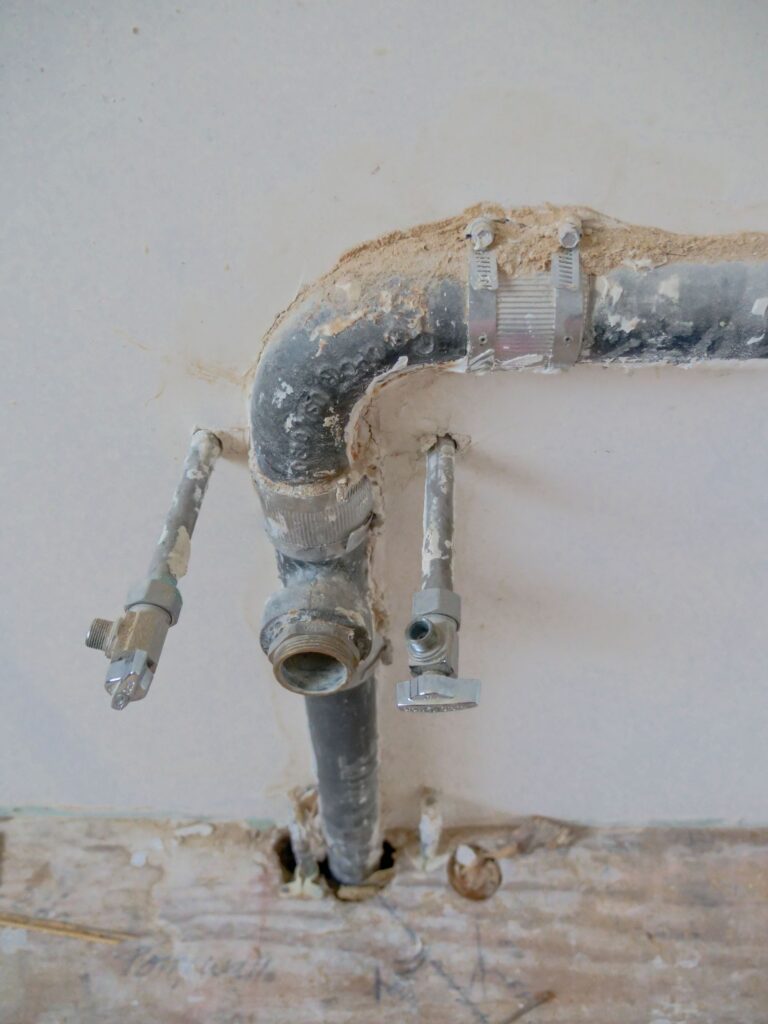
Supply and drain piping runs through framing, above ceilings and beneath floors. The first evidence a property owner usually sees is staining, bubbling paint, soft drywall, a warped board or a smell. Visible water comes later, if at all. By the time the surface shows a sign, the material behind it has often been wet for some time.
Water travels along framing before it collects and shows up, so a ceiling stain sits below the leak but often not directly below it. Cutting at the stain is one of the most common ways to miss the source by a considerable distance. So we work back from the stain to the plumbing, rather than opening the first damp spot we find.
Before we open anything, we confirm what type of leak we are dealing with. A pressurized supply leak runs constantly. A drain leak only appears when a specific fixture is used and then stops. A roof leak or air conditioning condensate problem presents similarly to a plumbing leak but is not a plumbing repair at all.
Sometimes the moisture is coming from a condensate drain or a roofing penetration. We would rather tell a customer that honestly than open a ceiling to find it out after the fact. Identifying the source correctly before opening anything is the entire point of the assessment.
SUPPLY LINES, IRRIGATION AND POOL LINES OUTSIDE THE HOUSE
Outside is where leaks run longest without being noticed, because the ground absorbs the water and nothing inside the building looks wrong. A supply line losing water in the yard leaves no interior sign at all. The first hint is the meter bill, or an unusually green strip of grass that draws someone’s attention.
The water service line running from the meter to the building is tested separately from the irrigation system and from pool plumbing. Mix all three together without isolating them first and it becomes impossible to identify which system is losing water. So the testing is done one system at a time. Irrigation faults include a weeping valve, a cracked lateral and a broken head. Each behaves differently and is found differently. None of them is the same problem as a supply line fault.
Pool plumbing presents a specific challenge. Water loss can come from a failing line, or from ordinary evaporation. The two have to be told apart before any digging or repair is warranted. We test the plumbing side of the system separately from the shell and equipment. The source of the loss is then confirmed rather than assumed.
Regional groundwater in this area is hard. That mineral content accelerates scale buildup and joint wear over time. It is one reason service line leaks are common in established neighborhoods. The repair path depends on what the line is made of, where it is, and how far the fault extends. Details covered on our water line repair page.
LEAKS UNDER THE SLAB ARE THEIR OWN INVESTIGATION
A leak in a line running beneath the foundation behaves differently from every other leak type. The signs, the access requirements and the repair options are all different enough that it is covered separately. Three signs point that way: a warm spot on a floor, or a meter that moves with the house isolated. The third is the sound of water running beneath a concrete slab.
That work is covered in detail on our slab leak detection page. It sets out the detection methods, the access options and the repair approaches that apply when a line runs under a foundation. The signs, the decision points and the repair scope are different enough that it warrants its own page and its own visit.
You may not be sure whether you are describing a slab leak or a different kind of leak entirely. Sorting that out is exactly what this visit does. We confirm which system is losing water and where before recommending a repair path.
Not sure where to start?
Talk to a licensed plumber
Describe what your plumbing is doing and we will tell you what it likely is before anyone comes out.
HOW WE NARROW A LEAK DOWN WITHOUT OPENING UP THE HOUSE
The process is about isolating sections of the system and watching how the meter responds to each isolation. When one section is shut off and the meter slows or stops, the leak is in that section. When it does not slow, the leak is somewhere else. This is how the area of uncertainty shrinks without any opening being made.
From there the location narrows further. We pressure test what can be isolated, and listen at accessible points. We take moisture readings at wall surfaces and floors, and inspect the plumbing that is directly visible. Each step rules something in or out. The goal at every step is to reach a point where opening one specific place is justified by evidence rather than by a guess.
We tell the customer what has been confirmed and what is still an inference before any wall or floor is opened. Confirmed means we have measured it, isolated it, or seen it directly. Inference means the evidence points that way strongly but is not conclusive yet. We say which one it is, rather than blurring the two.
We do not cut into a wall on a hunch. That approach creates a repair bill without solving the original problem, and a customer who comes to us after that experience is not unusual. Finding the source precisely before opening anything is what makes the repair targeted rather than exploratory. For suspected drain or sewer defects, a sewer camera inspection is often the most direct route. It confirms where the defect is and what it looks like before any digging is authorized.
WHAT HAPPENS ONCE THE LEAK IS LOCATED
Once the source is confirmed, the plumber explains what was found, where it is, and what the recommended repair involves. The repair goes into writing before anything is authorized. So the proposal states three things before any work begins. The scope. The access required. What the property will look like when the work is done.
Some leaks are straightforward enough to be corrected on the same visit once the location is confirmed. Others require access work, specific materials, or a return trip, and we say which one it is rather than leaving the customer to assume. If a repair requires a follow-up visit, the timeline and scope of that visit are described in the written proposal.
Drying, mold remediation and reconstruction are separate trades from plumbing, and we are direct about that. A customer with a wet ceiling or water damaged framing needs to know what we do. They need to know what a remediation contractor does. And they need to know in what order those things happen. We do not absorb work that belongs to another trade and we do not leave a customer uncertain about who handles what.
LEAK QUESTIONS WE GET ON THE PHONE
Can you find a leak without cutting into my walls?
In many cases, yes, because isolating the system and measuring moisture at accessible surfaces narrows the location before any opening is made. If access is required to confirm the source, we say so before cutting and explain exactly what will be opened and why.
My meter is moving but nothing looks wet. What does that mean?
It means water is leaving the system somewhere that is not visible from the surface, which is the most common situation we see. The source could be a line in the yard. It could be a toilet passing water silently. It could be a supply line inside a wall, or a line running beneath the floor. The visit is what determines which one.
Could a running toilet really explain my water bill?
Yes. A toilet with a failed flapper or a faulty fill valve can pass a significant volume of water into the bowl continuously, with no sound audible from the next room. It is one of the first things we check because it is also one of the simplest and least expensive things to correct.
How is a leak detection visit priced?
The plumber assesses the situation on-site, confirms the scope, and produces a written estimate before any repair work is authorized. You review the written figure and approve it before any work begins, so there are no surprises on the invoice.
OTHER PLUMBING WORK OUR TEAM HANDLES
Other licensed plumbing work from the same team:
LEAK DETECTION NEAR YOU
We work across College Station, Bryan and the towns around them. Pick your town, or check whether we cover your area.
START WITH A LEAK DETECTION APPOINTMENT
A suspected leak, an unexplained bill or a second opinion on someone else’s diagnosis all start the same way: Request an Appointment. The plumber assesses the situation, shows you what was confirmed, and provides written pricing before any repair is authorized.
If water is actively running into the building, a ceiling is holding water, or flooding is happening right now, that is an emergency. Call 979-473-9775 rather than scheduling an appointment.
Office hours Monday to Friday, 7 AM to 5 PM. Licensed plumbers on call 24/7 for plumbing emergencies.
Common questions
How long does a leak detection visit take?
Plan on a few hours rather than a few minutes, and understand that much of it is spent waiting and watching rather than working. Isolating one section at a time and reading how the meter responds is a sequence, and each step has to run long enough for the result to mean anything. A leak that is obvious once we are on site takes less. A slow loss across a large property with irrigation and a pool takes more. You hear what has been confirmed before we leave.
Should I stop using water before you arrive?
It helps if the property is quiet and stable for a while beforehand. Do not run the washing machine or dishwasher, turn the irrigation controller off, and switch off the ice maker, because a valve that cycles on its own makes a meter reading meaningless. If you can, run the meter test yourself the night before and write down what the low flow indicator did. Also make sure we can open the meter box and reach the main shutoff and the attic hatch.
Can you find a leak in a drain line, or only in pressurized pipe?
Both, but they are found in completely different ways, and this is where a lot of misdiagnosis happens. A supply leak runs constantly, shows at the meter, and responds to pressure testing. A drain leak only releases water when a fixture upstream of it is used, shows nothing at the meter, and cannot be pressure tested the same way. When the pattern points at the drain side, the tools are a camera in the line and isolation testing instead.
Can I get the wasted water credited on my bill?
Many utilities in this region have some form of leak adjustment policy, and just as many limit how often it can be used. It is worth calling your utility and asking directly, because the policy is theirs and the terms vary. What they usually want is proof the leak was located and repaired, meaning a dated invoice from a licensed plumber describing the work. We provide that as a matter of course. Ask before the next billing cycle closes rather than after.
The last plumber repaired a leak and the wet spot came back. What now?
Two possibilities, treated differently. Either the original diagnosis was wrong and the real source was never touched, or there was a second leak alongside the first, which is common when the pipe material itself is failing rather than one fitting. We start over rather than inherit someone else's conclusion, because accepting it is how the same mistake gets repeated at your expense. Bring whatever paperwork and photographs you have from the first visit, they are genuinely useful.
Does your equipment work through tile, hardwood and furniture?
Listening equipment works well through hard surfaces and poorly through soft ones. Tile and slab carry sound. Carpet with thick pad, floating floors and layered subfloor absorb it. Moisture meters need contact with the surface, and thermal readings need a temperature difference to see anything, so a leak that has cooled to room temperature is harder to image than one running hot. None of these tools sees through a wall like an x-ray, which is why we use several and compare what each one says.
What if you cannot find it?
You are told that plainly rather than watching a wall get opened so the visit looks productive. Some leaks are intermittent, some sit outside the systems we were asked to test, and some need conditions we cannot create on the day. What you get is a clear account of what was ruled out, what is still possible, and what the next step would be, whether that is a return visit, isolating the irrigation for a period, or another trade entirely. We do not guess at your expense.
What can I do to reduce the chance of the next one?
Have your static water pressure checked. Pressure above the normal working range stresses every joint, valve and appliance hose in the building, and a failed pressure regulator is both common and quick to find. Replace washing machine and water heater supply hoses on a schedule rather than after one lets go. Shut irrigation down for the season instead of leaving it cycling unwatched. If the water here has left scale on your fixtures, it is doing the same thing inside the pipe.
Have a plumbing question? Contact an expert.