
- LicensedTexas Master Plumber 40980
- On call 24/7Licensed plumbers for emergencies
- Brazos ValleyCollege Station, Bryan and nearby
A tankless unit heats water as it moves through the heat exchanger, so there is no stored volume sitting hot all day. Whether that suits a property depends on three things. How much hot water is used at once. What the gas supply and venting can support. How the water in the area treats the equipment.
4L Contracting evaluates, installs, repairs and maintains tankless water heaters in College Station, Bryan and the nearby Brazos Valley communities. Written pricing comes before authorized work begins.
Call 979-473-9775Request an Estimate
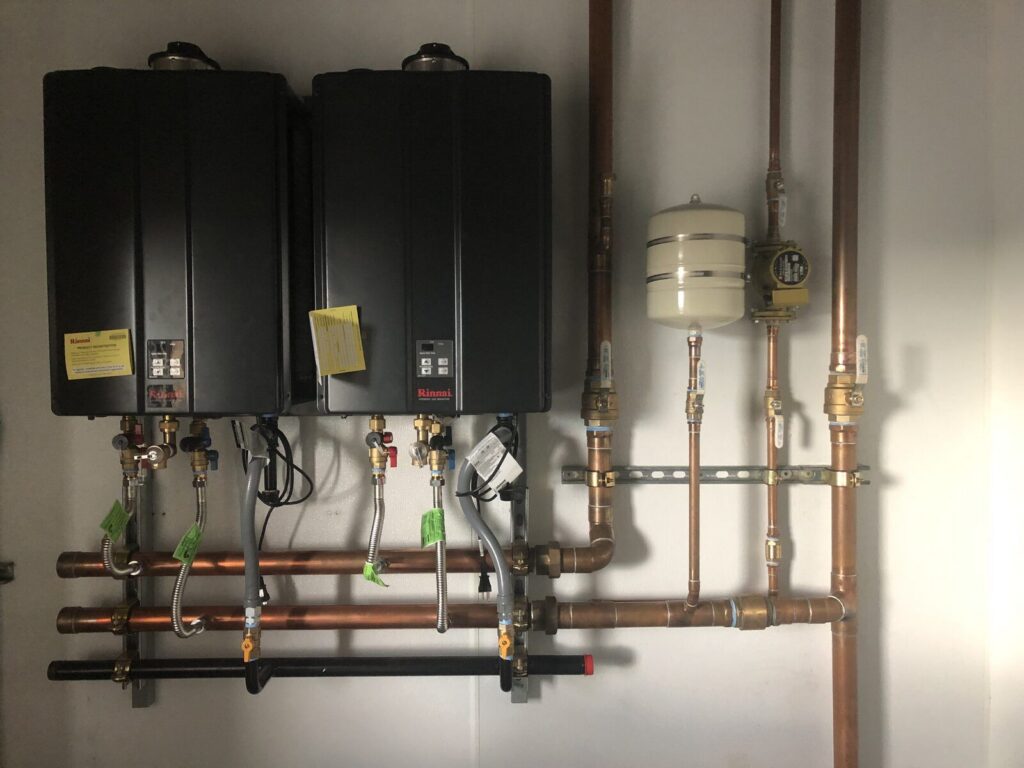
HOW A TANKLESS UNIT CHANGES THE HOT WATER QUESTION
With a tank, the question is how many gallons are stored and how fast the unit recovers after they are gone. Once the tank is empty the household waits, and recovery time depends on the burner or element and the incoming water temperature. The limit is visible and predictable.
With a tankless unit there is no reserve to run out of. The limit shifts to how much hot water the unit can produce at one instant. The unit fires on demand and shuts off when flow stops, so the constraint is no longer stored volume but instantaneous output capacity. That is a meaningful difference in how the system is sized and what a household can ask of it at any given moment.
This trades one kind of limit for another. It is the reason a household can be perfectly satisfied with a tank unit and still be disappointed by a tankless one. The difference is whether it was sized to match how they actually use hot water. The equipment is different enough that assumptions carried over from tank thinking do not transfer reliably.
FLOW RATE THINKING, AND WHY TANK CAPACITY DOES NOT TRANSLATE
Sizing a tankless unit means counting the fixtures that realistically run at the same time, and how much water each of them wants. It does not mean converting a tank size into an equivalent. A 50 gallon tank and a tankless unit serving the same house are not measured on the same scale. Trying to translate one into the other leads to an undersized installation.
The temperature of the incoming water matters because the unit has to raise it to the delivery temperature. Colder incoming water means less simultaneous output from the same equipment. A unit that performs well in summer may fall short when ground temperatures drop in winter. That seasonal variation is part of what the plumber accounts for when choosing equipment for this region.
The plumber walks the property and asks how the household actually uses hot water. The simultaneous draws that matter most are counted. Sizing comes from that specific load, not from a rule of thumb. That process takes longer than picking a unit off a chart, and it is the difference between equipment that works and equipment that disappoints.
What our customers say
Published exactly as written, straight from Google.
Found late Friday evening that I did not have hot water, and it was the weekend... YIKES!! Contacted 4L Contracting LLC; they came out within a couple of hours and had me working in a short time. Lee went above and beyond, letting me know about other problems identified in my attic, a problem with my chimney, and a heating vent installation problem. After he left, I found a water leak in the laundry room ceiling. He turned around and came back to my house. He found the air conditioning drain pipe was backed up. He blew it out the drain pipe, preventing a big disaster. So appreciate his thoroughness and helping me on a Friday after-hours house call. He definitely went above and beyond.
I had a great experience working with 4L Contracting LLC. They were awesome to work with, they were professional, responsive, and clearly knew what they were doing. We had a massive leak that needed immediate attention, and they showed up quickly and handled it efficiently. They not only fixed the issue fast but also made sure everything was done right. I would absolutely recommend them to anyone needing reliable, high quality work!
Used 4L Contracting the first time a couple years ago and since then they have replaced a water heater, reset toilets, replaced water lines, and located and fixed a leak under the house! They have been amazing to work with over the years, I cannot recommend these guys enough!
Water Softener installation Completed! Just wanted to give a shout out to Kurt and Lane on their outstanding customer service today. I hired 4L Contracting LLC to install a water softener in our home. After finding out the water softener I had purchased was missing parts, the job was rescheduled for Monday. I was able to return the water softener and get a replacement fairly quick. So I sent a text to Kurt, letting him know I had done so. He informed me they were nearby and could do the job in about 30 minutes if I could meet them back at my home. I hurried home and in about 2 hours the job was completed. Tonight my wife and I shall enjoy a soft water shower!
My husband and I had a broken pipe in the foundation and it was leaking pretty bad into our hallway, and 4L Contracting came that day we called, assessed the issue, and was back the next day and completely fixed the problem. They were so nice and helpful! I cannot tell you how pleased we were with their service. I recommend 4L Contracting!
My wife and I discovered a water leak coming out of our wall. 4L Contracting LLC came out that day and found where the leak was coming from (copper pipe leaking in the slab), they started working immediately and finished the next day.
These plumbers are honest, knowledgeable and reliable! They helped us fix a leak and answered all our questions about other issues in the house. Highly recommend!
Lee and his guys are Great. Their communication on our projects have been superb! Always letting us know when they will be at the job site. Lee is doing 3 projects for our Airbnb's at one time, and his organization of his paperwork is paramount for us.
WHAT IT COSTS AND HOW YOU PAY
The authorized work covers what the written scope describes. Problems hidden behind a wall or under the heater, gas or venting corrections, access work, or parts outside that scope are discussed and approved separately before work proceeds. There are no mid-job surprises because nothing additional happens without a second authorization.
Manufacturer parts coverage, where it exists, is separate from 4L workmanship coverage. Every repair and installation carries our workmanship warranty, with covered work, exclusions and customer obligations stated in the written proposal, authorization or invoice. If you have questions about what is and is not included, those answers come from the written document.
Our plumbing prices page explains how written estimates work and what to expect from the quoting process. It also explains why pricing is given after the plumber has seen the equipment and the installation, rather than over the phone.
GAS SUPPLY, VENTING AND ELECTRICAL DEMANDS OF A TANKLESS INSTALL
A tankless unit asks for more gas at once than most tank units. So the existing gas piping and meter capacity have to be checked before any equipment is selected. In a retrofit, the gas supply and the meter are sometimes the real work. They are evaluated as part of the scope, not discovered partway through the installation.
Venting is its own requirement. The exhaust materials, routing and termination point are specific to the unit and cannot simply reuse whatever the old tank heater used. A condensing unit also produces condensate that has to go somewhere. That drainage path is identified and built into the installation plan from the start.
Even a gas tankless unit needs electricity for the controls and ignition. That catches some property owners off guard. They are used to a standing pilot tank that runs without power. These building requirements are part of the scope and are identified before pricing, not discovered halfway through.
Gas supply work may be a significant part of what your property needs. Our gas line installation page covers what that work involves and how it is priced.
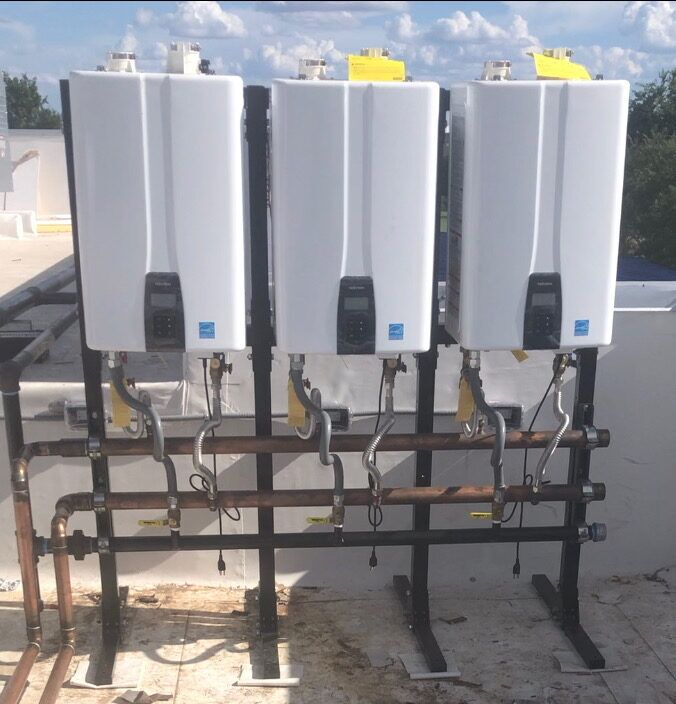
SCALE, DESCALING AND HARD WATER IN THIS REGION
Regional groundwater is hard, and scale collects on the heat exchanger over time. The heat exchanger is the component that does the work in a tankless unit. Scale buildup is the one maintenance item a tankless owner cannot ignore. Ignore it and the equipment will not perform as installed.
Scale shows up in three ways: reduced flow at the hot outlets, and temperature that wanders or refuses to hold steady. The third is a fault code on the display. Those symptoms look like a mechanical failure to someone unfamiliar with the equipment, but the fix is a flush rather than a repair. A flush is substantially less disruptive and less expensive than replacing a fouled exchanger.
Descaling is periodic maintenance, not a one-time event. We perform it and can explain what a property owner can reasonably do themselves between service visits. A unit that is never descaled will not deliver what it was sized to deliver. The shortfall grows gradually. It does not announce itself as an obvious failure. If you want to reduce scale accumulation at the source, water softening and filtration is worth reviewing for this region’s water.
WHEN TANKLESS IS NOT THE RIGHT ANSWER FOR A PROPERTY
Tankless may be the wrong call when the gas supply and venting cannot be brought up to what the unit needs without disproportionate work. Undersized gas piping, a new meter and proper venting all cost money to put right. That can make a tankless retrofit significantly more expensive than a straightforward tank replacement. There are properties where the calculus simply does not work in tankless favor.
It is also the wrong answer in three situations. When the demand pattern involves several large simultaneous draws on a regular basis. When nobody in the household is going to keep up with descaling. Or when the owner needs the simplest like for like replacement of a failed tank, and wants the work completed without an extensive retrofit.
We will tell a customer a tank is the better answer when that is what we think. We do not treat every inquiry as a conversion opportunity. You may have a planned tank replacement in mind, or a tank unit that is failing now. Those pages cover that work, and we are glad to have that conversation instead.
Not sure where to start?
Talk to a licensed plumber
Describe what your plumbing is doing and we will tell you what it likely is before anyone comes out.
REPAIRING A TANKLESS UNIT THAT IS ALREADY INSTALLED
Faults on an installed unit tend to fall into a few groups. Ignition and flame sensing, or flow sensors, controls and fault codes. Scale in the exchanger, or restricted venting and air supply problems. And a gas supply that is not delivering what the unit needs at firing demand. These are distinct failure modes and they do not all present the same way.
A fault code narrows the search but does not confirm a cause. The plumber inspects the unit and the full installation before recommending anything. A code that points at one component is sometimes produced by a condition elsewhere in the system. Part availability and the age of the equipment are part of that conversation, and we say so rather than proceed without it.
For an ongoing repair visit or a descaling appointment, use the Request an Appointment path below. Some things are an emergency: a gas odor, an active leak, an electrical concern, or continuing property damage. Call rather than wait on a form.
A gas odor, an active leak, an electrical concern or continuing property damage should be treated as an emergency. Call 979-473-9775 rather than waiting on a form.
QUESTIONS WE GET ABOUT GOING TANKLESS
Will a tankless unit really never run out of hot water?
It will not run out in the tank sense. It can fall short if the demand at a given moment exceeds what the unit can produce. The question is not whether there is stored water left. It is whether the unit was sized for the simultaneous draw you are placing on it.
Can a tankless unit go where my tank is now?
Sometimes. But a tankless unit has different gas, venting and electrical requirements from a tank. The existing connections often need work. The location and what it requires are evaluated as part of the scope before any pricing is given.
How often does a tankless unit need descaling?
In this region the interval is shorter than many manufacturers suggest. The groundwater is hard, and scale accumulates faster than it would in a softer water area. A plumber can look at the unit and the installation and give you a realistic schedule for this specific property.
How do I find out what a tankless installation involves for my property?
A written estimate starts with the plumber visiting the property. The gas supply, venting options and electrical situation are all looked at. The full job is scoped before any number is put in writing. Request an Estimate below to start that process.
OTHER WORK OUR PLUMBERS HANDLE
The same licensed team covers a full range of plumbing work across College Station, Bryan and the surrounding area:
TANKLESS WATER HEATERS NEAR YOU
We work across College Station, Bryan and the towns around them. Pick your town, or check whether we cover your area.
REQUEST A QUOTE OR AN APPOINTMENT FOR TANKLESS WORK
A new tankless installation or a replacement starts with Request an Estimate. A plumber will visit the property and evaluate the gas supply, venting and electrical situation. The full scope goes in writing before you authorize anything.
A repair, a fault code or a descaling visit on an existing unit starts with Request an Appointment. Bring whatever information you have about the fault and the equipment, and a plumber will follow up to confirm the scheduling details.
If you have an active plumbing emergency, call 979-473-9775 instead of waiting on a form. You can also reach us through our contact page.
Office hours Monday to Friday, 7 AM to 5 PM. Licensed plumbers on call 24/7 for plumbing emergencies.
Common questions
How long does an installation take, and will the gas be off?
A straight replacement of an existing tankless unit is usually a single working day. A conversion from a tank runs longer, because the gas supply, the venting and the electrical supply may all need work, and that is what turns one day into two. Gas to the appliance is off while we work, and water is off for part of the day. If the gas supply to the whole building has to be shut down, you get that window before the day starts, not during it.
Why is there still a wait before hot water reaches my shower?
Because the cold water already sitting in the pipe between the unit and the fixture has to clear first, and no water heater of any type changes that. A tankless unit adds a short delay of its own while it senses flow and fires. There is also a minimum flow rate below which it will not light at all, which is why a barely open faucet can run cold indefinitely. If the wait is the real complaint, the answer is a recirculation arrangement rather than different equipment.
Will it run in a power outage?
No. Even a gas tankless unit needs electricity for its controls, ignition and fan, so an outage means no hot water, unlike an old standing pilot tank. If you plan to run one from a generator, check the manufacturer's requirement first, because some electronics are particular about the quality of power a small generator produces. The usual safety warning applies as well: never run a generator in a garage, a crawl space, or anywhere its exhaust can reach the building.
Can I descale it myself between service visits?
Only if the installation has isolation valves with service ports on the hot and cold connections. Those valves are what make a flush possible without cutting into pipe, and if your unit went in without them the honest answer is that you cannot, and that adding them is the first job. Where they are fitted, a flush is a pump, a bucket and a descaling solution circulated for a period. We will show you on your own unit and give you a realistic interval for this property.
If I put in a water softener, can I stop descaling?
It slows the rate of buildup, it does not remove the maintenance. Softened water is much kinder to a heat exchanger, and owners with treatment usually stretch the service interval noticeably. What does not change is that a heat exchanger is a narrow passage carrying hot water, and hot water deposits minerals. Treat treatment as a way of making the interval longer and the exchanger last longer, not as a way of never opening the service valves again.
Will this actually cut my gas bill?
The honest answer is that it depends on how your household uses hot water, and we will not put a payback figure on it. A tankless unit keeps no stored volume hot around the clock, so the standing loss a tank carries all day is gone. A household using a lot of hot water in bursts sees less relative benefit than one using very little. Anyone who quotes you a precise saving without asking how you use hot water is guessing at it.
Can we install two units, or one just for part of the house?
Both are done. Two units can be linked to share the load where simultaneous demand is genuinely high, which comes up more on larger properties and on commercial work. A small dedicated unit serving a distant bathroom or a kitchen solves a long pipe run better than upsizing the main unit does. Whether either makes sense comes down to the gas capacity available and where a vent can terminate, and both of those are checked on the visit before anything is quoted.
It shows a fault code that clears when I cycle the power. Should I keep resetting it?
Write the code down along with what was running when it appeared, then stop resetting. A code is the unit telling you something specific, and an intermittent one that clears on a reset is often a venting restriction, an air supply problem, or a gas supply that falls short only under full firing demand. Those get worse rather than better. If there is a gas odor, an active leak or an electrical concern, treat it as an emergency and call.
Have a plumbing question? Contact an expert.