
- LicensedTexas Master Plumber 40980
- On call 24/7Licensed plumbers for emergencies
- Brazos ValleyCollege Station, Bryan and nearby
Honest answer first. If your home is on College Station or Bryan city water, your water is already soft, and a softener will not do much for you.
Homes on a private well are a different matter. Well water around the Brazos Valley can be hard, iron heavy or sandy, and those are the homes where treatment earns its keep.
4L Contracting installs and services water softeners, whole home filtration and drinking water systems for property owners in College Station, Bryan and the nearby Brazos Valley communities. We will tell you plainly whether you need equipment at all. Written pricing comes before authorized work begins.
Call 979-473-9775Request an Appointment
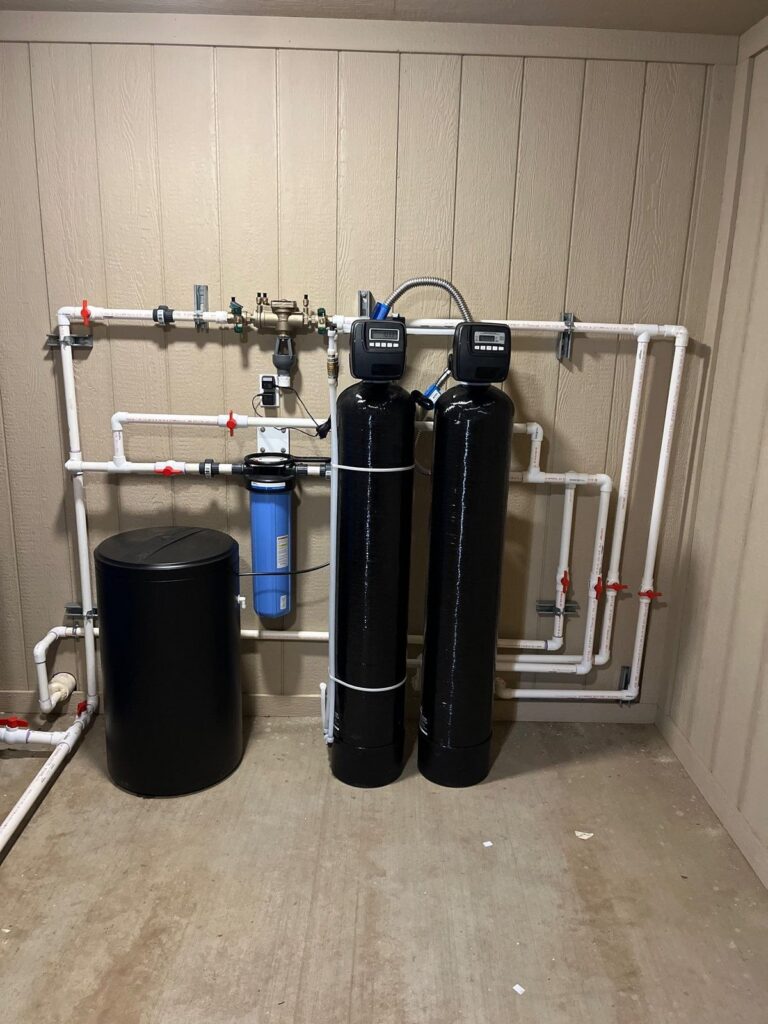
WHETHER YOUR HOME ACTUALLY NEEDS A SOFTENER
Start with where the water comes from, because that decides almost everything that follows.
- City water in College Station or Bryan. Both cities publish their hardness, and both are soft. College Station reports roughly 0.35 grains per gallon and Bryan roughly 0.45 grains per gallon, in the most recent reports, which carry 2022 sampling. Anything under about one grain per gallon counts as soft. A softener has very little hardness left to remove.
- A private well. Hardness, iron and sediment vary from one well to the next, sometimes between neighbours. A water quality test tells us what is actually in your water before anyone recommends equipment.
- Not sure which you have. Look at your water bill. If it comes from the city, you are on city water. Each city also publishes an annual water quality report you can read for yourself.
What local city water does carry is a high natural sodium level, which comes from the aquifer rather than from anything added. If that is your concern, a softener is the wrong answer, because ion exchange softening adds sodium rather than removing it. A reverse osmosis system at the kitchen sink is the fix for sodium, taste and dissolved minerals in drinking water.
WHAT HARD WATER LOOKS LIKE ON A WELL
These are the signs that show up on genuinely hard water, which in this area usually means a well.
- Spotting on glasses, fixtures and shower doors
- White crust building on aerators and shower heads
- Soap and shampoo that will not lather properly
- Laundry that feels stiff, and dry skin after a shower
- Scale inside the water heater, which shortens its life and costs efficiency
Tankless units are the most sensitive of all. Scale forms in the heat exchanger, flow drops, and service calls follow. If you run a tankless water heater on well water, treating hardness where the water enters the house protects the appliance.
What our customers say
Published exactly as written, straight from Google.
Water Softener installation Completed! Just wanted to give a shout out to Kurt and Lane on their outstanding customer service today. I hired 4L Contracting LLC to install a water softener in our home. After finding out the water softener I had purchased was missing parts, the job was rescheduled for Monday. I was able to return the water softener and get a replacement fairly quick. So I sent a text to Kurt, letting him know I had done so. He informed me they were nearby and could do the job in about 30 minutes if I could meet them back at my home. I hurried home and in about 2 hours the job was completed. Tonight my wife and I shall enjoy a soft water shower!
Found late Friday evening that I did not have hot water, and it was the weekend... YIKES!! Contacted 4L Contracting LLC; they came out within a couple of hours and had me working in a short time. Lee went above and beyond, letting me know about other problems identified in my attic, a problem with my chimney, and a heating vent installation problem. After he left, I found a water leak in the laundry room ceiling. He turned around and came back to my house. He found the air conditioning drain pipe was backed up. He blew it out the drain pipe, preventing a big disaster. So appreciate his thoroughness and helping me on a Friday after-hours house call. He definitely went above and beyond.
I had a great experience working with 4L Contracting LLC. They were awesome to work with, they were professional, responsive, and clearly knew what they were doing. We had a massive leak that needed immediate attention, and they showed up quickly and handled it efficiently. They not only fixed the issue fast but also made sure everything was done right. I would absolutely recommend them to anyone needing reliable, high quality work!
Used 4L Contracting the first time a couple years ago and since then they have replaced a water heater, reset toilets, replaced water lines, and located and fixed a leak under the house! They have been amazing to work with over the years, I cannot recommend these guys enough!
My husband and I had a broken pipe in the foundation and it was leaking pretty bad into our hallway, and 4L Contracting came that day we called, assessed the issue, and was back the next day and completely fixed the problem. They were so nice and helpful! I cannot tell you how pleased we were with their service. I recommend 4L Contracting!
My wife and I discovered a water leak coming out of our wall. 4L Contracting LLC came out that day and found where the leak was coming from (copper pipe leaking in the slab), they started working immediately and finished the next day.
These plumbers are honest, knowledgeable and reliable! They helped us fix a leak and answered all our questions about other issues in the house. Highly recommend!
Lee and his guys are Great. Their communication on our projects have been superb! Always letting us know when they will be at the job site. Lee is doing 3 projects for our Airbnb's at one time, and his organization of his paperwork is paramount for us.
WHAT SOFTENING DOES, AND WHAT IT DOES NOT DO
A salt based softener works by ion exchange. It trades the calcium and magnesium that form scale for sodium, or for potassium if you prefer. Sized and set correctly, and kept stocked with salt, it greatly reduces scale in your pipes, fixtures and water heater.
It is worth being equally clear about what softening does not do. It does not purify water or remove contaminants. It does not correct taste, odor or chlorine. It carries no health benefit. Softened water feels slicker and lathers more easily, which some households like immediately and others take a while to get used to.
WHAT TREATMENT COSTS AND HOW YOU PAY
You get a written price after a site visit, listing what is included. Nothing is added to it without your written approval. These are starting prices for standard work during normal business hours, and they match our plumbing cost estimator.
- Water quality testing and recommendation. Starting at $185. Testing only, with equipment quoted separately.
- Water softener installation, you supply the softener. Starting at $1,200.
- Water softener supplied and installed by 4L. Starting at $2,500.
- Whole home carbon filtration, you supply the filter. Starting at $1,250.
- Reverse osmosis drinking water system, under the kitchen sink. Starting at $950.
- Water softener repair. Starting at $375.
Those figures assume the install location already has the water, drain and electrical connections the equipment needs. Adding a softener loop, pouring a pad, running an electrical outlet, major pipe changes and specialty equipment are quoted separately once we have seen the house.
Our installation work carries a two year workmanship warranty. Equipment warranties come from the manufacturer.
SALT BASED SOFTENING COMPARED WITH SALT FREE CONDITIONING
| Category | Salt based softener | Salt free conditioner |
|---|---|---|
| Removes hardness minerals |
Yes. Ion exchange takes the calcium and magnesium out of the water. |
No. It alters the minerals so they are less inclined to stick as scale. |
| Softened feel and lather |
Yes. Water feels slicker and soap lathers more easily. |
No. The water feels the same as it did before. |
| Needs salt |
Yes, topped up on a schedule. |
No. |
| Needs a drain |
Yes, for the regeneration cycle, with an air gap as code requires. |
No. |
| Adds sodium |
Some. Potassium chloride is an option if that matters to you. |
No. |
| Upkeep |
Salt refills, settings and a clean brine tank. |
A cartridge or media change. |
Which one suits you comes down to three things: what you are trying to fix, where the equipment can physically go, and how much maintenance you want to take on.
WHOLE HOME TREATMENT COMPARED WITH POINT OF USE FILTRATION
Whole home equipment treats every drop entering the house. That is the right answer for hardness, iron or sediment coming off a well.
Point of use filtration treats water at one place, normally the kitchen sink or the refrigerator line. That is the practical answer when the goal is better drinking and cooking water.
Plenty of well water homes end up with both, a softener for the house and a drinking water filter at the sink. For city water customers here, an under sink reverse osmosis system is usually the single most worthwhile upgrade, because it reduces sodium and dissolved minerals along with taste and odor.
WHAT FILTRATION IS FOR, MEANING TASTE, ODOR, SEDIMENT AND CHLORINE
Filters address what you can taste, smell or see, which means chlorine, odors, sediment and cloudiness. We match the filter to the problem rather than selling one filter for everything.
If the worry is something more serious, such as bacteria, nitrates or arsenic in a well, the first step is a laboratory water test. We install and pipe the equipment correctly, and we will point you to a lab for the water chemistry rather than guess at it.
THE FILTER MEDIA WE USE AND WHAT EACH ONE FIXES
A whole home tank filter is only as good as the media inside it. Different media solve different problems, so we match the media to your water test.
| Media | What it fixes | Good to know |
|---|---|---|
| Activated carbon |
Chlorine, taste, odor and some organic chemicals. |
The most common whole home filter. It does not touch hardness, iron or bacteria. |
| Catalytic carbon |
Chloramine, hydrogen sulfide and chlorine. |
Outperforms standard carbon on chloramine and sulfur. Often follows a chlorine or air system. |
| KDF, copper and zinc |
Chlorine and some heavy metals. |
Slows bacterial growth inside the filter. Usually blended with carbon to extend its life. |
| Birm |
Iron and manganese. |
Needs enough oxygen and a pH around 6.8 or higher. Will not address sulfur smell. |
| Manganese dioxide |
Iron, manganese and hydrogen sulfide. |
Common in air injection iron systems. Heavy media, so it needs a strong backwash. |
| Greensand |
Iron, manganese and hydrogen sulfide. |
Normally paired with chlorine or another oxidizer. |
| Calcite and Corosex |
Raising low pH on acidic water. |
Adds some hardness back, so a softener may be needed after. The media is consumed and has to be topped off. |
| Sediment and multimedia |
Sand, silt and cloudy water. |
Usually the first stage on well water. |
| Tannin or nitrate resin |
Tea colored water or nitrates. |
Specialty resins that regenerate with salt. Chosen from laboratory results. |
Most well water problems need more than one media, installed in the right order. A good test comes first.
IRON BREAKERS, CHLORINE SYSTEMS AND UV DISINFECTION
Iron in well water leaves orange staining, a metallic taste and red slime in toilet tanks. Hydrogen sulfide is the rotten egg smell. An iron breaker, also called an air injection system, handles both without chemicals. The tank holds a pocket of air, iron and sulfur oxidize as water passes through it, the media catches the resulting particles, and the system backwashes on a schedule to flush them out.
Two things matter before we recommend one. Your well pump has to deliver enough flow to backwash the tank properly, which we check first. And every system has a ceiling on how much iron, manganese and sulfur it can handle. Very high levels, or iron bacteria, call for a chlorine system instead. An iron breaker goes in ahead of the softener, so the softener is not fouled with iron.
A chlorine injection system adds a small measured dose of chlorine, and is the stronger choice for high iron, strong sulfur smell or bacteria. It uses a metering pump or pellet feeder, a contact tank that gives the chlorine time to work, and a carbon filter afterwards to remove what is left along with the taste and smell. It takes more upkeep than an air system, since you refill chlorine and check the dosing.
Ultraviolet disinfection kills bacteria, viruses and other microorganisms as water passes a UV lamp. It adds nothing to the water and changes nothing about the taste. It only works on clear water, because iron, manganese, hardness and sediment coat the sleeve and block the light, so it needs prefiltration and it goes last in line, after the filters and the softener. The lamp is normally replaced about once a year and the quartz sleeve cleaned as needed. We size it to your home flow rate and look for systems certified to NSF/ANSI 55 Class A, which is the certification standard for residential UV disinfection. UV is common on private wells after a laboratory test shows bacteria. It is not needed on city water, which is already disinfected.
Not sure where to start?
Talk to a licensed plumber
Describe what your plumbing is doing and we will tell you what it likely is before anyone comes out.
HOW WE SIZE A SYSTEM
A system that is too small runs out of capacity and lets hard water through. One that is too large wastes salt and water and can struggle at low flow. We size from your water test and from how your household actually uses water.
Take a well measuring 15 grains per gallon, which is well water rather than anything you would see on city water here. Four people using around 75 gallons each per day works out at 4,500 grains a day, or roughly 31,500 grains a week. That points to a 48,000 grain softener, because nameplate capacity is a laboratory figure and a unit run at an efficient salt setting delivers noticeably less than its rating.
Flow rate matters as much as capacity. The equipment has to keep up when several fixtures run at once, so we look at the number of bathrooms, the pipe size and your peak demand. Undersized valves and tanks cause pressure drops. On backwashing filters we confirm your pump can deliver the minimum backwash flow the tank size requires.
On well water a typical order is a sediment prefilter, then an iron breaker or chlorine system with its contact tank, then a carbon filter, then the softener, with UV last. Your setup may need fewer stages than that. We only recommend what the test supports.
WHERE THE EQUIPMENT GOES, AND THE DRAIN AND BYPASS IT NEEDS
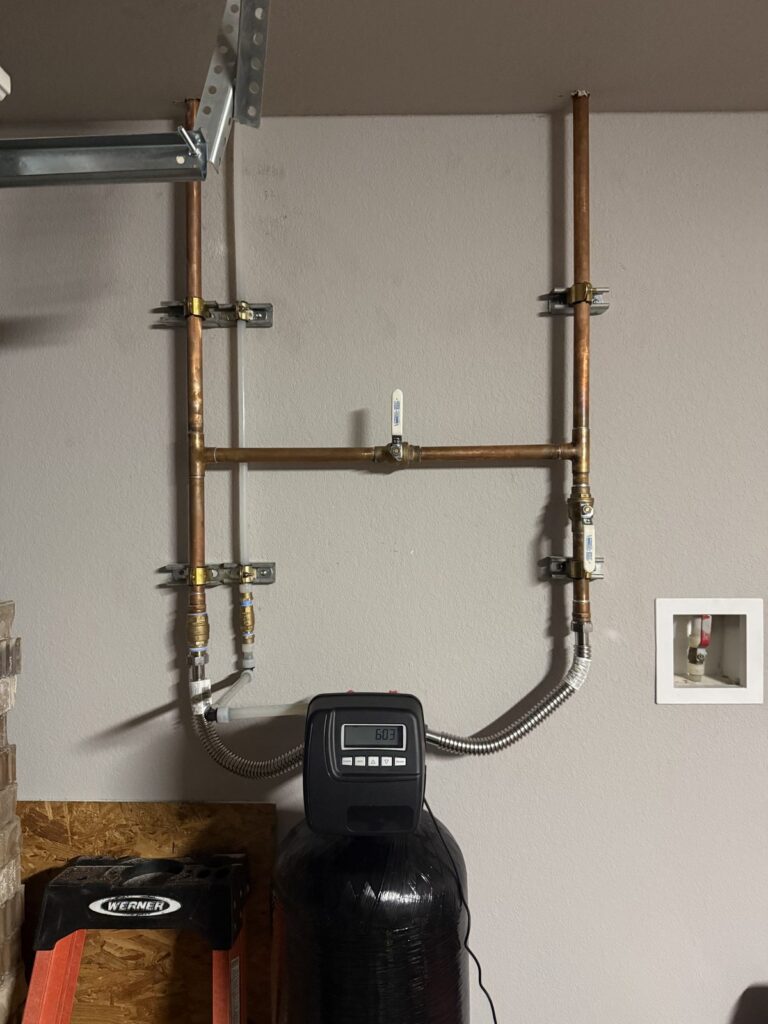
This is the part customers rarely anticipate. A softener needs a spot on the main water line with room to service it, power if the control valve requires it, a drain for the regeneration cycle with an air gap as code requires, and a bypass valve so the unit can be taken offline without shutting water to the whole house.
We normally connect outside hose bibs and irrigation ahead of the softener, since there is no reason to soften water for the lawn. We can also leave the kitchen cold water unsoftened if you would rather drink water without the added sodium. Garages, utility rooms, outside walls and spots near the meter each bring their own complications. We agree the location and the connection plan with you before any work is authorized.
FITTING TREATMENT TO A HOUSE THAT WAS NOT PLUMBED FOR IT
Many homes in this area were built without a softener loop, without a drain connection and without space set aside for equipment. In those houses, a good part of the job is running the piping needed to get treated water where you want it.
That is why we look at the house before quoting. The equipment price is predictable. The piping is not. If the sensible install location turns out to be somewhere other than where you expected, we will explain why. The full scope is in writing before you approve it.
SALT, SETTINGS AND THE MAINTENANCE AN OWNER TAKES ON
A salt based softener needs salt added on a schedule, a reasonably clean brine tank, settings that match your household, and an occasional check that it is still regenerating.
Filters run on their own schedule. A whole home carbon tank needs new carbon roughly every five years. Carbon cartridges usually last somewhere between six and twelve months. Changing them on schedule matters, because a spent filter quietly stops doing its job.
We walk you through the routine when the installation is finished, and we service softeners and filters we did not install. If you would rather not deal with any of it, ask about our water treatment maintenance program, which covers salt, settings and filter changes for you.
OTHER PLUMBING SERVICES WE PROVIDE
Other plumbing work from the same licensed team in College Station and Bryan:
WATER SOFTENERS NEAR YOU
We work across College Station, Bryan and the towns around them. Pick your town, or check whether we cover your area.
ARRANGE A WATER TREATMENT CONSULTATION
Maybe you want a new softener. Maybe a replacement for equipment that has stopped working. Maybe filtration for taste and odor. Or maybe a straight opinion on whether your household needs either one at all. They all start the same way: Request an Appointment. We assess the site, explain what we found, and provide written pricing before any work is authorized. If your interest is a different water source rather than treating the one you have, see rainwater collection.
If water is leaking from equipment or piping and causing damage right now, that is an emergency. Call 979-473-9775 rather than scheduling an appointment, and we will get to it.
Office hours Monday to Friday, 7 AM to 5 PM. Licensed plumbers on call 24/7 for plumbing emergencies.
Common questions
Do I need a water softener in College Station or Bryan
Usually not, if you are on city water. Both cities report soft water, under one grain per gallon. A softener makes sense on a private well with genuinely hard water. If you are on city water and dislike the taste, a drinking water filter or reverse osmosis system is the better fix.
Does a water softener add sodium to my water
Yes. A salt based softener trades hardness minerals for sodium, so the softer the water becomes, the more sodium it carries. If you are on a sodium restricted diet, speak to your doctor. The options are potassium chloride in place of salt, leaving the kitchen cold line unsoftened, or adding reverse osmosis at the sink.
What is the difference between a softener and a filter
A softener reduces the hardness minerals that cause scale. A filter improves taste, odor, sediment or chlorine. They solve different problems, and some homes need both.
Does a water softener need a drain
A salt based softener does, for its regeneration cycle, with an air gap as code requires. A salt free conditioner does not.
Can you install a softener I already bought
Yes. We install customer supplied equipment. We check that it is complete and correctly sized for your home before we begin.
Can a water softener drain into my septic system
Often yes, though it depends on the system. Texas Health and Safety Code Chapter 366 allows softener discharge to a conventional septic tank and drain field where the softener conserves water, regenerates on demand based on water use rather than on a timer, and carries the required external label. On an aerobic system the softener drain has to bypass the treatment unit and discharge to the pump tank or the approved disposal method, rather than being tied into a house drain feeding the unit. The TCEQ rules at 30 TAC 285.37 also require the discharge to enter through an air gap. Regeneration sends extra water into the system as well, which matters if your septic is already struggling. We will ask which type you have and confirm with your septic provider or the Brazos County authorized agent where needed.
How long does a water softener last
Plan on ten to fifteen years for a quality unit, sometimes longer with good maintenance. Your water and your usage both affect that. A softener will often need a resin or valve repair before the whole unit needs replacing.
How often does a carbon filter need new media
Budget for new carbon in a whole home tank roughly every five years. Replaceable cartridges usually run six to twelve months. Heavy use or poor water shortens both. Replacing the carbon does not mean replacing the filter, because a serviceable tank simply takes new media.
How is a softener or filtration installation priced
We look at the house first. The equipment is only part of the price. The piping, the drain and the location vary from one home to the next. You receive a written price and approve the work before we start.
Have a plumbing question? Contact an expert.